
Never Again is Now
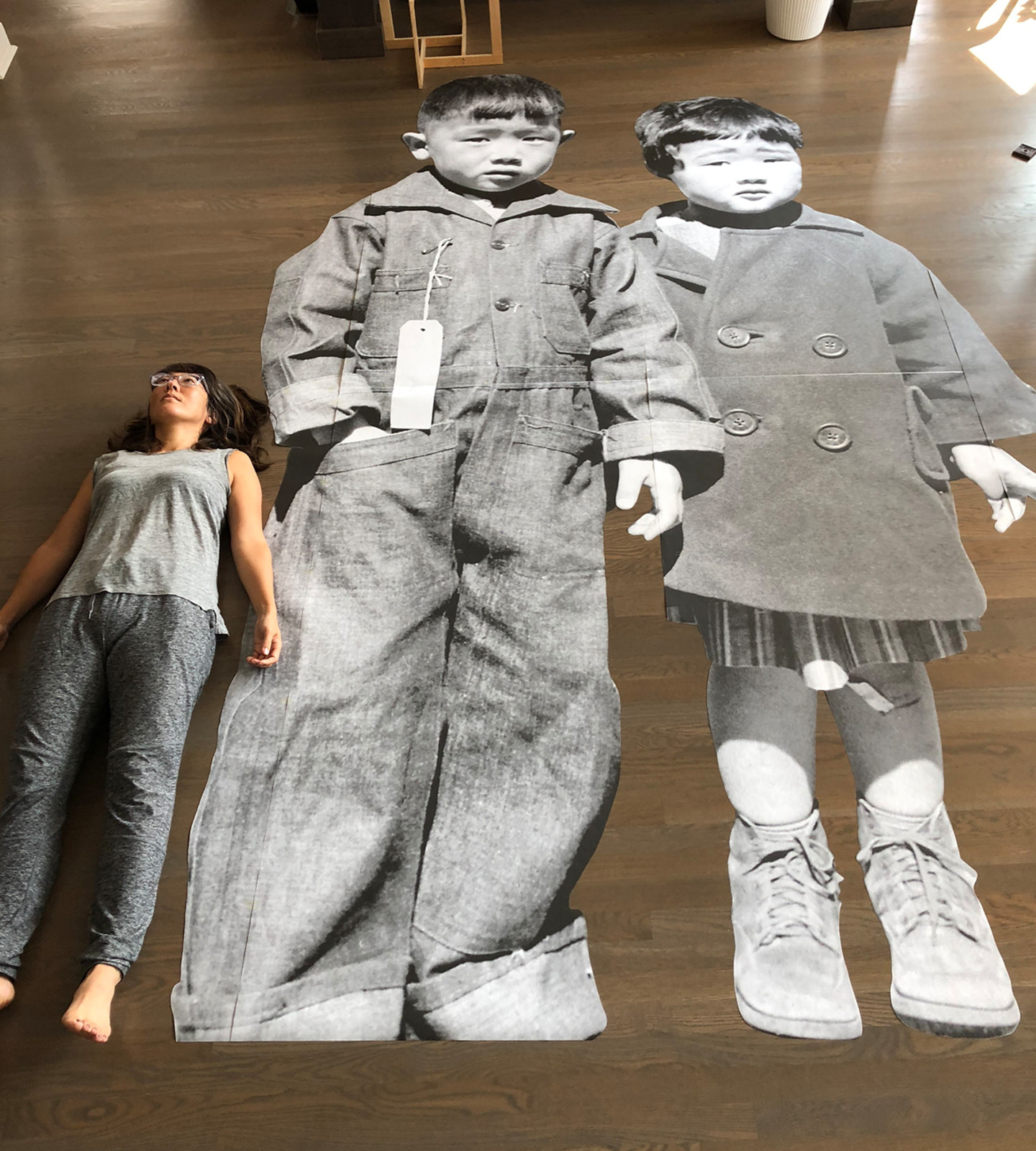
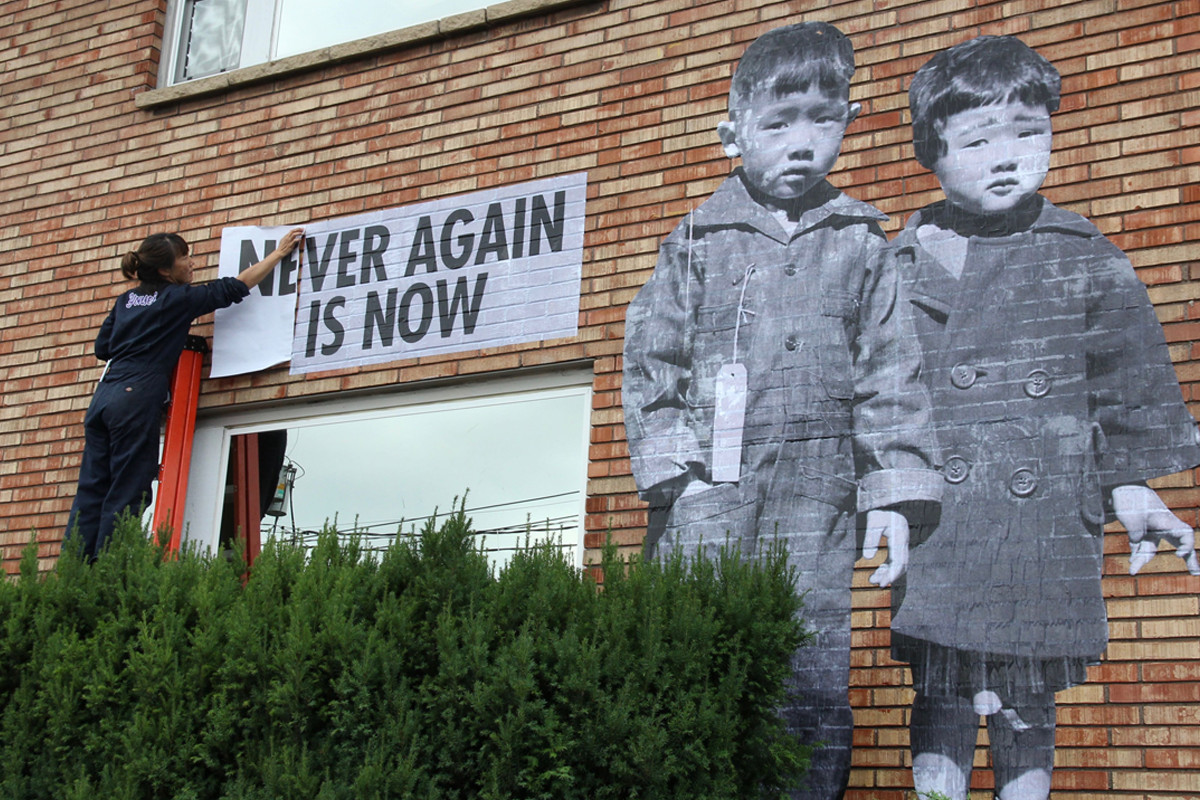
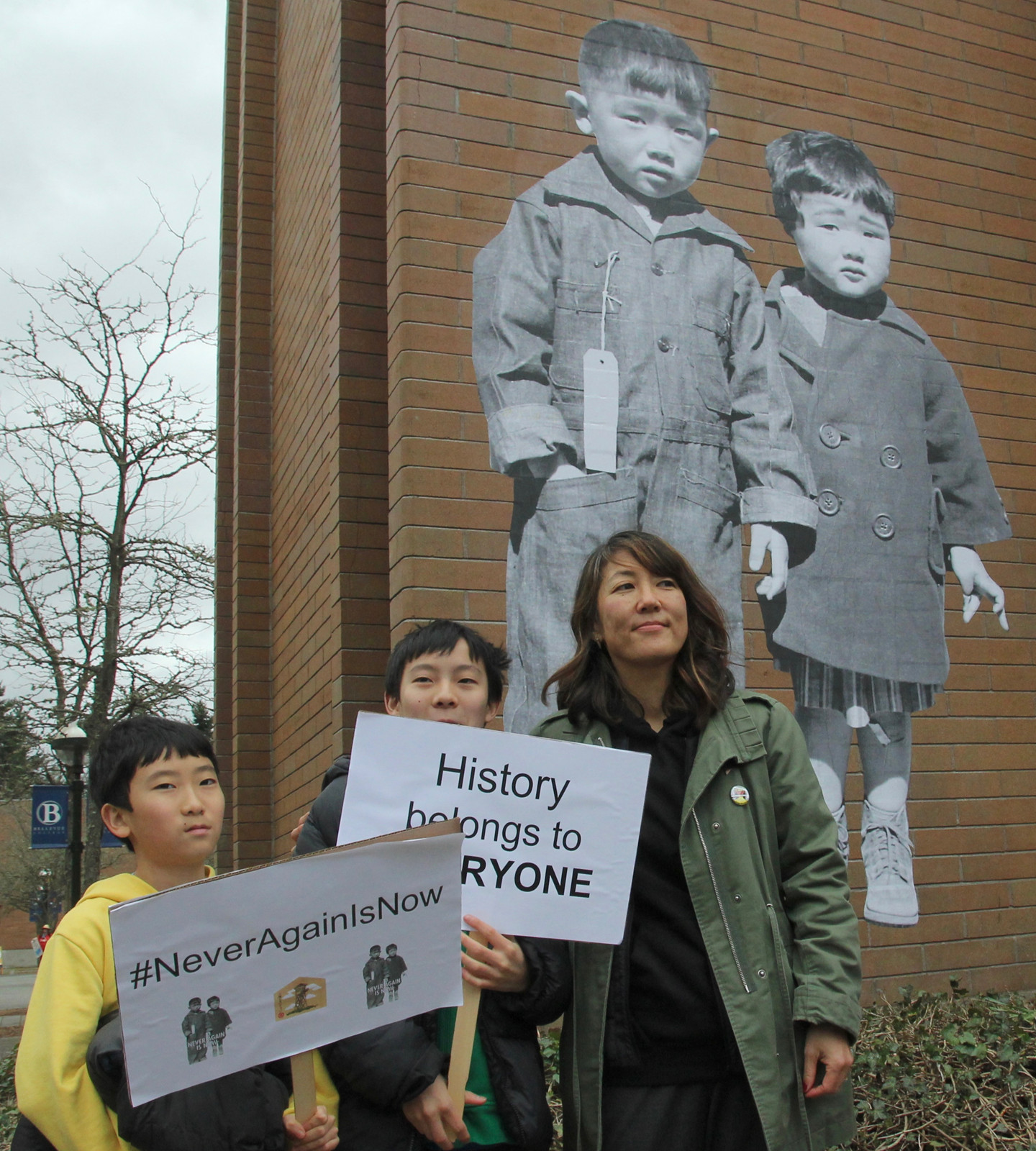
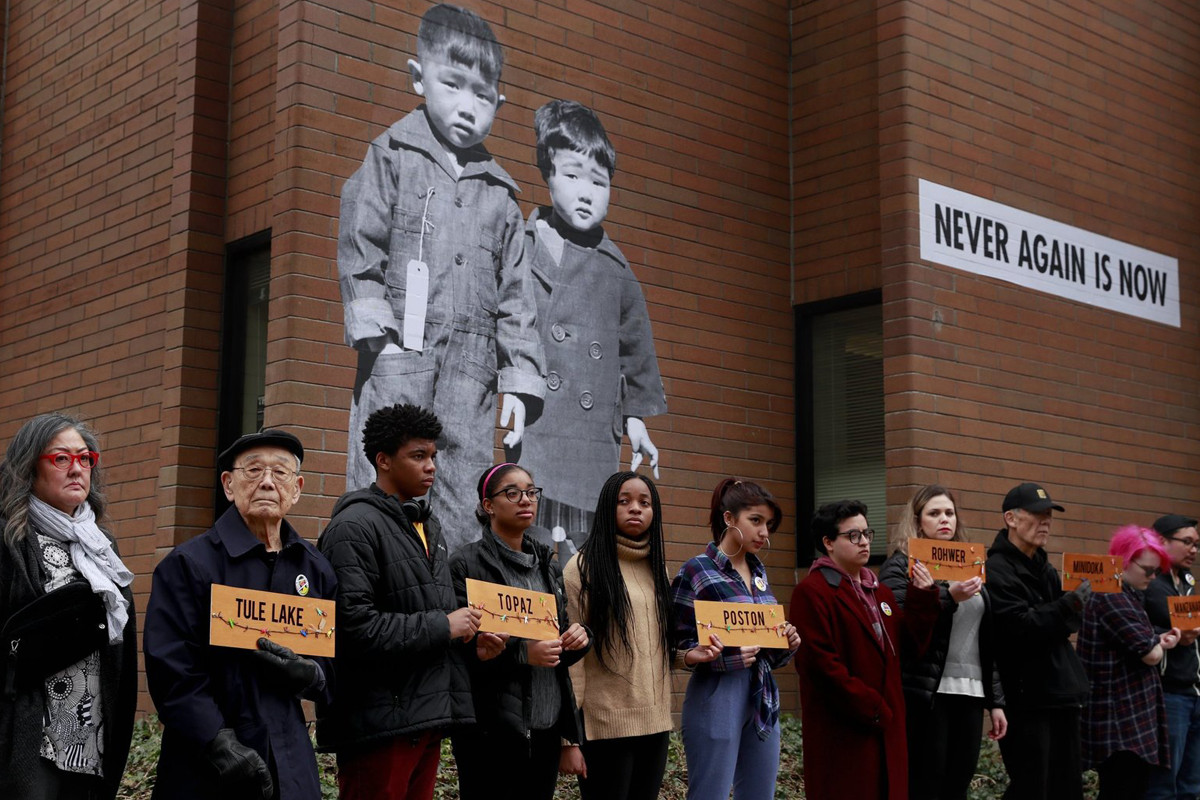
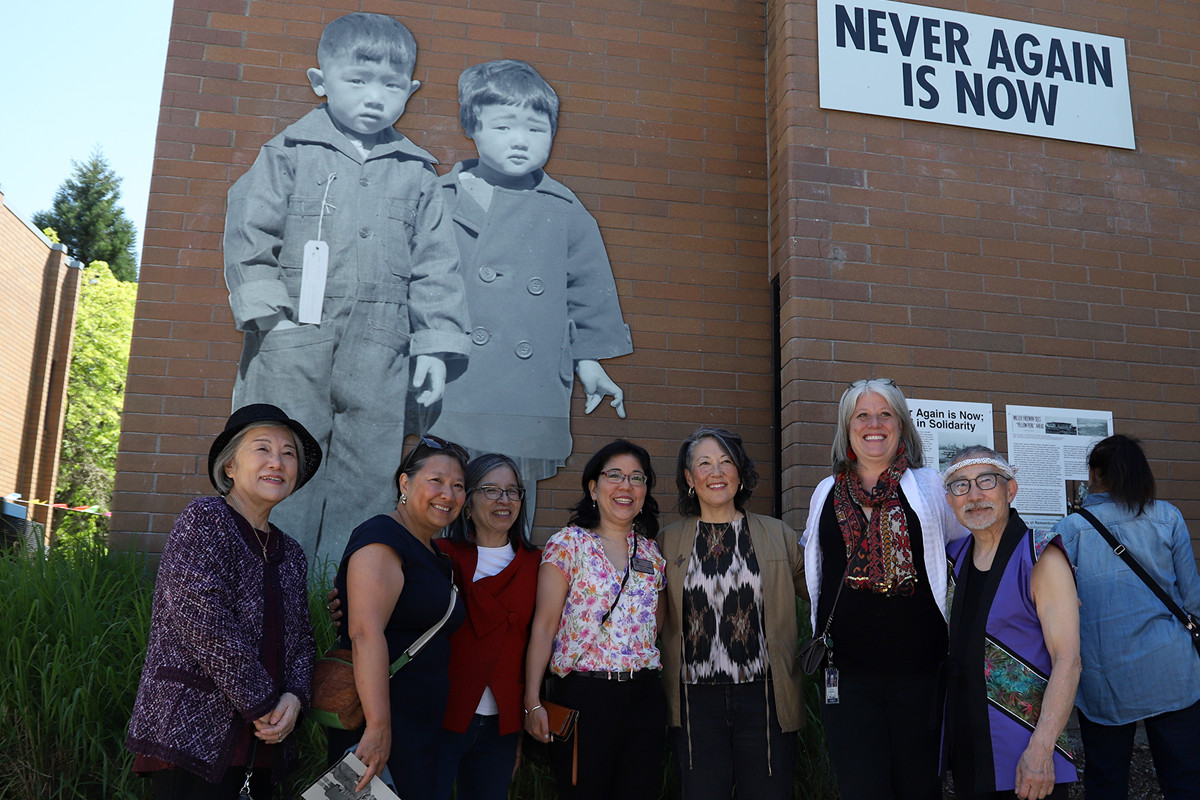
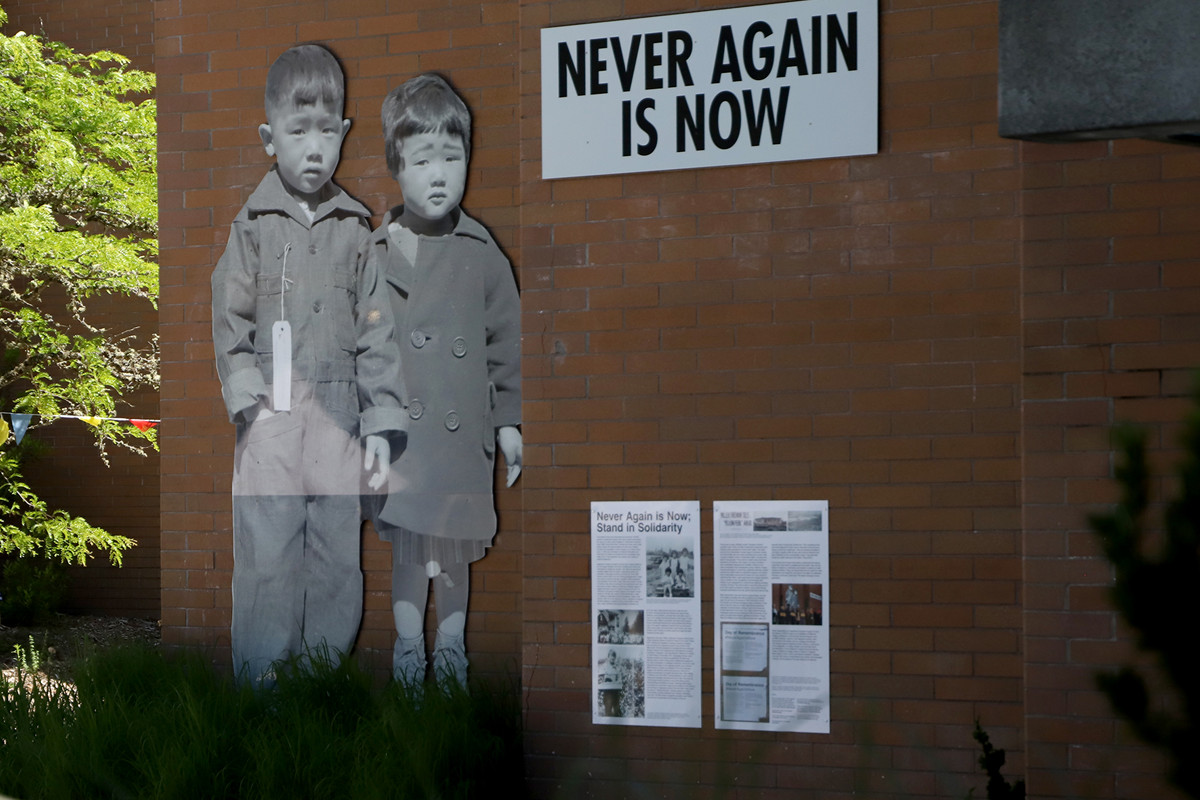
2018 + 2019, as temporary public art, acrylic, wheat pasted paper on brick, 11 feet x 7 feet, at Densho in Seattle, WA, then at Bellevue College, Bellevue, WA
2026, as a permanent commission, digital on aluminum composite, Bellevue College, Bellevue, WA
The original Bellevue College version of this project was defaced in broad daylight by a high level college administrator in 2019. She and then then president lost their jobs in the community furor that arose.
Here is the text as it appears in the 2026 permanently commissioned piece:
Never Again is Now; Stand in Solidarity
This exhibit honors and remembers the more than 120,000 persons of Japanese ancestry who were unjustly incarcerated for nearly four years under President D. Roosevelt’s Executive Order 9066 during World War II. Almost two-thirds were United States citizens and approximately one-third were children. Families lost businesses, homes, property, and years of their lives. In 1983, the Commission on Wartime Relocation and Internment of Civilians concluded that the incarceration was solely due to “race prejudice, war hysteria, and a failure of political leadership.”
Japanese immigrants played a pivotal role in shaping Bellevue and the larger Eastside community. Building upon lands long stewarded by Indigenous peoples, their labor and agricultural expertise helped drive the region’s agricultural growth and prosperity. They began arriving around the turn of the 20th century, most of them men from farming backgrounds in Japan who came to work the railroads, sawmills, timber operations, and canneries of the Pacific Coast. When they chose to remain in America, they often turned back to the agricultural work they had known at home. Bellevue at the time consisted largely of logged-over land covered in acres of stumps and brush, the remnants of old-growth forests cleared by the region’s timber industry in the late 19th century. White landowners, unable or unwilling to rehabilitate the land themselves, leased small parcels, often five to ten acres at a time, to Japanese immigrant workers seeking to establish farming communities of their own. Under contracts that typically allowed cultivation for up to ten years, these farmers first had to clear the land by hand, removing stumps and dense brush using horses, mattocks, and dynamite, a process that could take a year or more. Once cleared, the land produced a wide range of crops, including peas, lettuce, cucumbers, and other fresh produce, though strawberries became the most profitable and defining crop of the region’s Japanese American farming community. After several years, soil productivity would decline, and many families would relocate to another parcel and begin the labor-intensive process again.
Beginning in the early 1900s, Japanese immigrant farmers lived under a growing climate of suspicion fueled by the racist “Yellow Peril” narrative and baseless conspiracy theories portraying them as loyal to the Japanese emperor and a threat to the West Coast. This fear persisted for decades and was reinforced through a series of anti-Japanese laws that restricted property ownership, immigration, and naturalization. Following the attack on Pearl Harbor in December 1941, advocates of these racist theories pointed to the attack as justification for their long-standing claims, further fueling public hysteria and support for the mass incarceration of Japanese Americans. Among the most influential advocates of anti-Japanese policies was publisher Miller Freeman, founder and president of the Anti-Japanese League, who used his political and economic influence to advance exclusionary immigration and land laws. After settling in Medina in the mid-1920s, Freeman became a major force in shaping the Eastside’s development and is often described as a driving figure behind projects, such as the Mercer Island Floating Bridge and Bellevue Square. Following Pearl Harbor, he emerged as a prominent regional voice calling for the removal of all persons of Japanese ancestry from the West Coast under the guise of “national security,” casting suspicion on entire communities, including American-born citizens. Ultimately, more than 125,000 people of Japanese ancestry were forcibly removed and incarcerated for the duration of the war.
These prison camps, officially named “relocation centers,” operated under a host of similar bureaucratic euphemisms that softened public perceptions of their harsh reality. That reality was that they incarcerated a broad range of American citizens and their families who lost nearly everything they owned under a massive violation of their constitutional rights, including their rights to due process. These were not death camps like those operated by the German Nazi regime, but camp conditions were nonetheless miserable and unhealthy. Moreover, the mass incarceration itself represented a gross violation of basic American principles of criminal law, especially detention without evidence but rather based on prejudiced suspicion and racism. Some incarcerated persons found routes out of the camps by performing farm labor under supervised work-release programs. Later, a number of men volunteered, and eventually were drafted, to join segregated U.S. armed forces fighting overseas, primarily in Europe. They did so both to leave the camps and to prove their loyalty as American citizens, even as their families remained imprisoned by the very government they were serving.
When World War II was over and the camps closed, very few of the Bellevue families who were rounded up and shipped away into rail cars in the spring of 1942 were able to return. The handful who did had managed to place ownership of their farms under the name of a citizen Nisei (second generation Japanese American) family member; most of the remainder moved elsewhere to find work. For a 1992 Journal-American newspaper series commemorating the 50th anniversary of the event, journalist David Neiwert gathered the stories of these Nisei from Bellevue and found that survivors were eager and adamant about having their stories told. They understood that what had happened to them was an example of the American Dream turned into a nightmare—that core shared principles of civil rights, equality under the law, and common decency had been shattered by the concentration camps. They saw their stories as a stark warning to the nation. They still do.
The survivors who shared their stories understood that silence made their incarceration possible and that racism, fear, and the failure of neighbors, institutions, and leaders to speak up made injustice possible. Today, as communities are torn apart by mass deportations and detention, we must be the allies the Japanese American community never had. This lesson belongs to every generation.
When descendants of Japanese immigrants sought to honor this history in 2020 through an art installation at Bellevue College, references to the role that influential figures, such as Miller Freeman, played in anti-Japanese activism were removed from the display text by a college administrator. The decision sparked significant public criticism, contributed to the resignation of college leaders, and ultimately led to the restoration of the installation’s original historical framing. Today, as Bellevue College works to make Erin Shigaki’s “Never Again Is Now” mural a permanent installation, debates over how this history is remembered and publicly acknowledged continue. Yet the ghosts of the past refuse to be silenced.
This project was created with the assistance and support of Natasha Varner, Alexis Silva, Leslie Lum, Belle Nishioka, Densho and many other community members.
Photo Credits
2-3, 5-6: Eugene Tagawa
4: Erika Schultz, Seattle Times